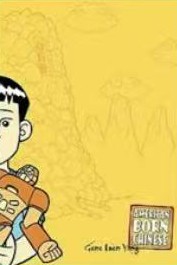
What This Book Is About
Three stories run in parallel and the reader is not told, at first, what they have to do with each other. In the first, the Monkey King of Journey to the West masters every discipline of kung fu but is turned away from a dinner in heaven for being a monkey, and is imprisoned under a mountain of rock for five hundred years. In the second, Jin Wang moves with his parents from San Francisco's Chinatown to a suburb where he is one of two Asian American children in the school, and wants more than anything to be someone else. In the third, an all-American boy called Danny is visited every year by his cousin Chin-Kee, who is drawn as a grotesque nineteenth-century caricature, speaks in a deliberately offensive accent, and ruins Danny's life.
The three strands converge, and the convergence is the argument of the book. Yang uses the shape of a superhero comic and the oldest story in Chinese literature to write about the specific shame of wanting to stop being yourself, and about what it costs to accept the shape you were given. It won the Michael L. Printz Award in 2007, was a finalist for the National Book Award in 2006, and won the Eisner Award for Best Graphic Album. It was the first graphic novel ever nominated for a National Book Award.
Available at Kinokuniya, Popular bookstores, and the Singapore National Library.
Why UWC Chose This Book
For a school where most students hold more than one cultural identity, this is close to a set text. Jin Wang's problem is not racism in the abstract; it is the daily, ordinary wish to be read as someone else, which is a feeling many students at an international school recognise before they can name it. Yang does not resolve it with a speech about pride. He makes the reader sit with the caricature of Chin-Kee first, uncomfortably, and only then shows what it was doing there.
It is also a serious piece of teaching about form. The book asks a reader to hold three narratives at once and to notice that the connections are visual rather than stated, which is exactly the work a Grade 7 student needs to practise before tackling multi-stranded prose. And because the panels carry much of the meaning, students whose English is still developing can read it at full depth while they are still building vocabulary.
Reading Level Guide
The sentences are short and the pictures carry the story, so the words themselves are readable at A2. The difficulty is not the language.
Where we place it. A B1 reader can hold the three storylines together and see why the caricature of Chin-Kee is in the book, which is the point of reading it.
Quick to read at B2, and worth rereading. It is taught at senior level as often as at middle school.
Other UWC Recommended Books for This Grade
Not sure if this book is right for your child? Take our free 30-minute English assessment to find their CEFR level, then choose books that match.