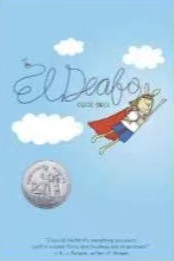
What This Book Is About
When Cece was four years old, she got meningitis. She survived, but the illness destroyed most of her hearing. Suddenly the world went from loud and clear to muffled and confusing. Starting school meant wearing a bulky, box-shaped hearing aid called a Phonic Ear, with wires that connected to a receiver the size of a small radio strapped to her chest. She looked—and felt—like an alien.
At school, some kids stared at the device. Others pretended Cece didn't exist. Making friends became an exhausting minefield of misunderstandings and hurt feelings. But then Cece discovered something unexpected: her Phonic Ear could pick up the signal from her teacher's wireless microphone, letting her hear everything the teacher said anywhere in the entire school—in the hallway, in the staff room, even in the bathroom. Cece had a secret superpower. She gave herself a new identity: El Deafo, superhero.
This Newbery Honor graphic novel memoir is drawn with charming, expressive illustrations where all the characters are rabbits—a gentle artistic choice that makes the emotional content accessible without being overwhelming. It is simultaneously laugh-out-loud funny and deeply moving, honest about the loneliness of being different while celebrating the strength it takes to be yourself.
Available at Popular bookstores, Kinokuniya, and the Singapore National Library.
Why We Recommend This Book
A uniquely accessible and impactful book for A2-B1 readers. Three reasons it belongs on every international school student's shelf.
First, the graphic novel format makes it highly accessible—visual storytelling supports comprehension even at lower English levels. Students who struggle with text-heavy novels can follow the story through illustrations while gradually building their reading vocabulary. Research consistently shows that graphic novels are one of the most effective formats for developing reading fluency in second-language learners.
Second, disability representation and themes of inclusion are central to international school values and the IB Learner Profile. Cece's story teaches empathy not through lectures but through lived experience—readers feel what it's like to be the one who's different. In schools like UWCSEA, Tanglin, and SAS, where diversity and inclusion are core values, this book sparks genuine classroom conversations about what it means to truly include everyone.
Third, the memoir format teaches students about autobiographical writing—a common assignment in English Language Arts classes. Students see how a real person shapes their life story into a narrative with structure, humor, and emotional arc. When they're asked to write their own personal narratives, they'll have a brilliant model to draw from.
Reading Level Guide
The graphic format helps, but vocabulary may still be challenging at A1. A great first step with parent support.
Ideal level. The illustrations support comprehension perfectly at this range.
A quick, rewarding read at B2. Pair it with Out of My Mind for a deeper exploration of disability themes.
Other UWC Recommended Books for This Grade

Not sure if this book is right for your child? Take our free English assessment to find their CEFR level, then choose books that match.