
Why Global Investors Are Rethinking Access
For internationally mobile families and investors, access to global markets has quietly become harder to take for granted. Across several jurisdictions, regulators have tightened the rules on cross-border online brokerages that let residents trade foreign securities, and the direction of travel is toward more oversight, not less.
The most prominent recent example came in May 2026, when China's securities regulator and seven other agencies ordered unlicensed cross-border brokers into a two-year wind-down, during which existing mainland clients may only sell rather than buy, and proposed large fines on several major platforms. The regulator framed the action as protecting market order and limiting unsupervised capital outflows.
Source: Xinhua News Agency / China Securities Regulatory Commission, China to penalize 3 brokerages over illegal cross-border trading, May 2026, english.news.cn
Changes like these have led some globally-minded investors to look beyond a single platform or jurisdiction and toward more durable arrangements. One option that comes up repeatedly is acquiring a second citizenship through investment, a legal route offered by a number of sovereign governments. It is a real tool, but it is widely misunderstood, so it helps to start with what it actually does.
What a Second Citizenship Actually Does
A citizenship acquired by investment is a full, recognized nationality granted by a sovereign state. It gives you that country's passport, the right to live and work there, and visa-free or visa-on-arrival travel to a set of other countries. For many families, the appeal is having a second, stable base that does not depend on any one government's policies.
What it does not do, on its own, is change where you live or where you are taxed. This matters for the financial-access question. International brokers and banks generally onboard clients based on tax residency, not nationality. A firm like Interactive Brokers, for example, asks for proof of identity, proof of a residential address, and a tax form declaring your country of tax residence, and your country of residence determines which entity holds the account and how it is reported. A passport answers the identity question; it does not by itself answer the residency question.
Source: Interactive Brokers LLC, Tax Information and Reporting: Tax Residency, and account application requirements, 2026, interactivebrokers.com
So a second citizenship can broaden the set of jurisdictions and institutions available to you, and it can be a genuine part of a longer-term plan. But it works alongside decisions about residency and tax residency, and it should be used in compliance with the rules of every country involved.
A second passport is a legal status, not a shortcut. To benefit from it, most people also need to address where they live and where they are tax-resident, confirm their home country's rules on holding more than one nationality, and take professional cross-border legal and tax advice before acting.
Pairing a Passport with a Low-Tax Residence
Because a passport does not change where you are taxed, the second half of the picture is where you actually become a tax resident. That is decided by where you genuinely live, broadly the number of days you are physically present plus where your home and economic life are centered, and most countries treat you as tax-resident once you spend more than 183 days a year there. The practical result is that the passport and the place you are taxed are usually two different things. Almost nobody relocates to St Kitts or Dominica; instead they hold the passport as a travel and backup document and separately base themselves somewhere livable with low or no tax.
Source: Tax residency is generally based on physical presence, commonly 183 days or more per year, plus where a person's home and economic interests are located (general international tax principle; PwC Worldwide Tax Summaries, IRAS), 2026
Zero personal income tax
A number of jurisdictions levy no personal income tax at all, on salary, dividends, capital gains, or interest. The Gulf states lead the list, with the United Arab Emirates the most accessible thanks to its residence-visa and golden-visa routes and a large international community. Qatar, Bahrain, Kuwait, Oman, and Saudi Arabia are also zero on personal income, as is Monaco in Europe, though Monaco is extremely expensive and French nationals living there remain taxed by France. Several Caribbean and Atlantic jurisdictions are zero too, including the Bahamas, the Cayman Islands, and Bermuda. Notably, three of the citizenship programs in this guide come from countries that themselves levy no personal income tax, namely St Kitts and Nevis, Antigua and Barbuda, and Vanuatu, so a person who genuinely moved there would owe no local income tax, although few applicants do.
Source: Jurisdictions with no personal income tax on salary, dividends, or capital gains include the UAE, Qatar, Bahrain, Kuwait, Oman, Saudi Arabia, Monaco, the Bahamas, the Cayman Islands, and Bermuda; among citizenship-by-investment countries, St Kitts and Nevis, Antigua and Barbuda, and Vanuatu also levy none (PwC Worldwide Tax Summaries; investment-migration compilations, third-party), 2026
Territorial systems that leave foreign income untaxed
A second group taxes only locally-sourced income and leaves foreign income alone. Hong Kong and Singapore both fall here, and crucially neither taxes capital gains: in Hong Kong, investment income and gains can be received free of tax, and in Singapore, foreign-sourced income is exempt for individuals even when brought into the country. Outside Asia, Panama and Georgia run similar territorial systems where foreign-earned income is generally not taxed. For someone whose income comes mainly from a global investment portfolio, a territorial hub can be as effective as a zero-tax one, without requiring a move to the Gulf.
Source: Hong Kong and Singapore tax treatment: no capital gains tax, territorial basis, and foreign-sourced income exemption for individuals (PwC Worldwide Tax Summaries; Inland Revenue Authority of Singapore); Panama and Georgia operate territorial systems, 2026
| Jurisdiction | Personal income tax | Capital gains tax | Note |
|---|---|---|---|
| UAE (Dubai) | 0% | None | Most accessible; residence or golden visa; large expat community |
| Gulf states (Qatar, Bahrain, Kuwait, Oman, Saudi Arabia) | 0% | None | No personal income tax; residency rules vary by country |
| Monaco | 0% for residents | None | Very high cost; French nationals remain taxed by France |
| Bahamas / Cayman / Bermuda | 0% | None | No income tax; residency by investment or property |
| Hong Kong | Territorial, up to about 15% on local salary | None | Investment income and gains generally untaxed |
| Singapore | Territorial, 0 to 24% | None | Foreign-sourced income exempt for individuals |
| Panama / Georgia | Territorial | None or low | Foreign-earned income generally not taxed |
| St Kitts / Antigua / Vanuatu | 0% | None | Some of the passports in this guide come from zero-tax countries |
The rules keep moving
These regimes are not permanent, so plan with current advice. Thailand, long a territorial favorite, began taxing foreign income remitted by its tax residents from 2024, narrowing a long-standing exemption, with a partial easing now under draft for the 2026 tax year. Portugal closed its popular non-habitual-resident tax regime to new applicants, replacing it from 2025 with a far narrower scheme aimed at science and innovation professionals. The wider trend is more reporting and more scrutiny, not less, so a structure that works today should be reviewed against the rules in force when you act.
Source: Thailand began taxing remitted foreign-sourced income of its tax residents from 1 January 2024, with a draft relief proposed in 2025 for the 2026 tax year (STEP; Thai Revenue Department)
Source: Portugal closed the Non-Habitual Resident regime to new applicants under the 2024 State Budget (transitional window to 31 March 2025), replacing it with the IFICI regime, Government Order No. 352/2024/1
None of this works on paper alone. To be taxed somewhere new, you have to genuinely live there, usually 183 days or more, with a real home and ideally a tax-residency certificate. Your bank or broker will report the account to your country of tax residence under the global Common Reporting Standard, and your previous home country may keep taxing you until you genuinely cease to be resident there. This is a real relocation and a question for a cross-border tax adviser, not a formality.

The Programs, Compared
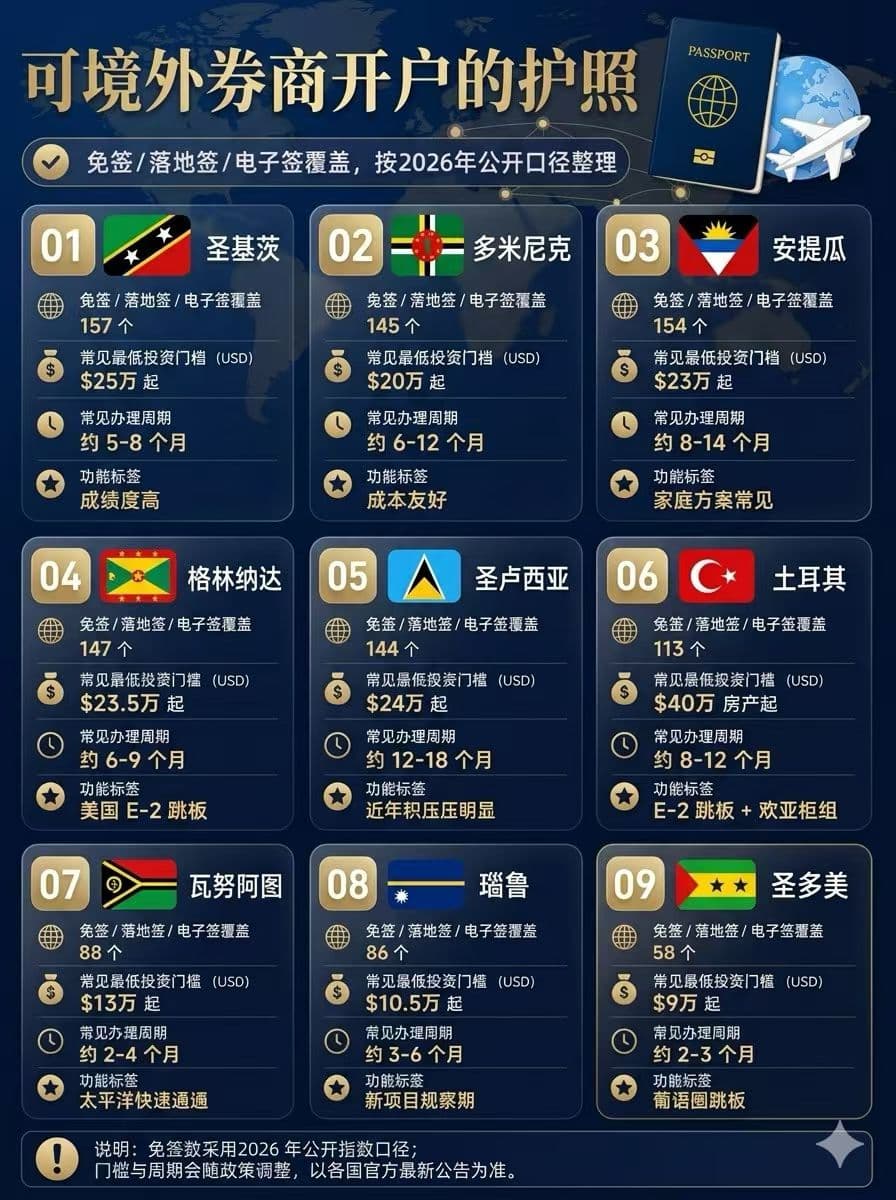
The programs that come up most often fall into three loose tiers. The established Caribbean programs are the best known and most widely recognized. Turkey sits in its own category because its route is a recoverable real-estate investment rather than a donation. A handful of lower-cost and newer programs round out the list, with the trade-offs covered further below. Cost is only one factor, and rarely the most important one.
| Country | Minimum investment | Typical timeline | Investment type | Notable |
|---|---|---|---|---|
| St Kitts & Nevis | US$250,000 (SISC donation) or US$325,000 real estate | About 4 to 9 months | Donation or real estate | Longest-running program; shifting toward a residency model in 2026 |
| Dominica | US$200,000 (EDF donation) or US$200,000 real estate | About 6 to 9 months | Donation or real estate | Lowest Caribbean entry; mandatory interviews |
| Antigua & Barbuda | US$230,000 (NDF donation) | About 4 to 8 months | Donation | One price covers a family of up to four |
| Grenada | US$235,000 (NTF donation) or US$270,000 real estate | About 6 to 9 months | Donation or real estate | Only Caribbean country with a US E-2 treaty |
| St Lucia | US$240,000 (NEF donation) or US$300,000 real estate | About 6 to 12+ months | Donation or real estate | Flexible routes; current processing backlog |
| Turkey | US$400,000 real estate (or US$500,000 deposits) | About 6 to 12 months | Recoverable real estate | Large economy; asset can be resold after 3 years |
| Vanuatu | US$130,000 (donation) | About 1 to 4 months | Donation | Fastest, but no EU or UK access (see limitations) |
| Nauru | About US$105,000 to 115,000 (donation; promotional rate near US$90,000 to 95,000 until 30 June 2026) | About 3 to 4 months | Donation | Launched 2025; funds climate resilience; limited reach |
| Sao Tome & Principe | US$90,000 single / US$95,000 family (donation) | About 2 to 3 months | Donation | Newest and lowest cost; Portuguese-language ties; smallest reach |
Source: Minimum contributions: St Kitts and Nevis CIU (ciu.gov.kn); Commonwealth of Dominica CBIU (cbiu.gov.dm); Antigua and Barbuda CIU (cip.gov.ag); Grenada Citizenship by Investment Act 2013, via Henley and Partners; Saint Lucia CIU under Citizenship by Investment Act No. 14 of 2015, 2026
Source: Republic of Vanuatu Department of Immigration (immigration.gov.vu); Republic of Nauru Economic and Climate Resilience Citizenship Program (ecrcp.gov.nr); Republic of Turkiye citizenship-by-investment regulation, US$400,000 real estate or US$500,000 deposits (cross-checked across investment-migration providers; third-party); Sao Tome and Principe Decree-Law 07/2025 (program figures via licensed agents; third-party), 2026
The split that matters most is donation versus recoverable investment. Donation routes, which include all the cheapest options, are one-time payments to a government fund and are not returned. Turkey's real estate, and the higher Caribbean real-estate tiers, leave you holding an asset you can in principle resell after a holding period of three to five years, though property carries its own market and liquidity risk.
Thinking globally about your child's education too?
A second base abroad often goes hand in hand with university and schooling decisions. Oak helps internationally mobile families plan.
Features Worth Understanding
Grenada and the US E-2 visa
Grenada is the only Caribbean citizenship program whose nationals can apply for the US E-2 treaty investor visa, which lets an investor live in the United States to run a qualifying business, with a spouse able to work and children able to study. One caveat matters: US law applies a three-year domicile requirement when treaty nationality was acquired through a financial investment such as a donation, so the timing and route need planning. This is not the same as US permanent residency, and the business must be real and operating.
Source: U.S. Department of State, Treaty Countries (E-2) list (Grenada is a treaty country); three-year U.S. domicile requirement under 8 U.S.C. for treaty nationality acquired by financial investment, 2026
Turkey's recoverable real estate
Turkey's route is a property purchase of at least US$400,000 held for three years, after which it can be sold while citizenship remains. That makes it the main program where most of the capital is tied to an asset rather than given away, though the value depends on choosing the right property. Turkish nationals are also eligible for the US E-2 visa. A Turkish passport does not, however, provide visa-free access to Europe's Schengen area.
Sao Tome and the Portuguese-language route
Sao Tome and Principe is a member of the Community of Portuguese Language Countries, which can give its citizens preferential treatment with Portugal, including a shorter path to Portuguese naturalization, reported at around seven years rather than ten. It is the newest and cheapest program, so this potential is best treated as a long-term consideration rather than a near-term benefit.
Source: Community of Portuguese Language Countries (CPLP) framework; Sao Tome and Principe citizenship programme (third-party investment-migration sources), 2026
The Limitations and Risks
The single most volatile benefit is visa-free travel, and it has been shrinking. The United States has suspended visa privileges for Antigua and Barbuda and for Dominica over concerns about their programs. The United Kingdom ended visa-free entry for Dominica in 2023 and for St Lucia in March 2026. The European Commission has stated that operating an investor-citizenship program can in itself justify suspending Schengen access, and has urged the five Eastern Caribbean states to strengthen vetting pending discontinuation of their programs. Vanuatu has already lost Schengen visa-free access entirely. Treat any visa-free count as a snapshot, not a guarantee.
Source: U.S. travel restrictions on Antigua and Barbuda and Dominica, and UK visa changes (Dominica 2023; Saint Lucia March 2026), as reported by Investment Migration Insider (IMI Daily); European Commission, 8th Visa Suspension Mechanism Report, 2025 to 2026
Source: Council of the European Union, removal of Vanuatu from the EU visa-exempt list, effective 12 December 2024
Headline figures understate the true cost. Donation routes are non-refundable, and on top of the contribution every program adds due-diligence fees, government processing fees, and licensed-agent fees, which together can add tens of thousands of dollars, especially for families. Real-estate routes tie up more capital and depend on the project performing.
Reach and recognition vary widely. The newest programs, Nauru and Sao Tome, have only existed for months and reach the fewest countries, and Vanuatu's reputation was damaged by the EU action. For the specific goal of being accepted by international banks and brokers, a brand-new micro-state passport is the weakest tool, not the bargain its low price suggests.
Programs themselves keep changing. St Kitts and Nevis is restructuring toward a residency-based model and requires existing citizens to complete biometric enrollment by mid-2027, and several other Caribbean programs plan minimum-residency requirements. Processing times can lengthen as compliance tightens, and multi-passport structures face growing scrutiny under global tax-transparency and beneficial-ownership rules. None of this is a reason to avoid these programs, but it is a reason to plan with current, professional advice rather than a marketing brochure.
How to Choose
The right choice depends on the goal, not the price. If the priority is a recognized, durable nationality with the broadest acceptance, the established Caribbean programs or Turkey are the stronger starting points. If the aim is to live and run a business in the United States, Grenada's E-2 eligibility is genuinely unique. If keeping the capital recoverable matters most, Turkey's real estate is the main route. And if the goal is simply a low-cost backup nationality, the newer programs can serve that purpose, as long as their limited reach and short track record are accepted with eyes open.
Beyond the program itself, weigh the donation-versus-asset question, the full cost including fees, the realistic processing time, and how stable the program looks given the reforms underway. Families pursuing a second base abroad are often planning their children's education in parallel; our guide for families choosing an international school is a useful companion read.
Finally, this article is general information, not legal, financial, tax, or immigration advice. Programs, fees, and travel privileges change frequently, and the right structure depends on your individual circumstances. Anyone considering this route should work with licensed professionals and confirm the current rules that apply to them.
Frequently Asked Questions
Is acquiring a second citizenship by investment legal?
Yes. Citizenship by investment is a legal route offered directly by sovereign governments and administered through licensed agents, subject to due diligence and background checks. What you must check separately is your own country's position on holding more than one nationality, which varies widely, and it is wise to confirm this with a qualified professional before applying.
Will a second passport let me open an international brokerage account?
It can broaden your options, but a passport alone is not enough. Brokers and banks generally onboard clients based on tax residency and require proof of a residential address and a tax declaration, not just nationality. A second citizenship is one piece of a larger plan that also involves where you live and where you are tax-resident.
Which program is the cheapest and fastest?
As of 2026, Sao Tome and Principe is the lowest-cost option at around US$90,000 and is among the fastest, while Vanuatu is typically the quickest at roughly one to two months. The trade-off is that the cheapest and newest programs offer the least global reach and the shortest track record.
Do these passports give visa-free travel to Europe and the United States?
The established Caribbean programs have historically offered visa-free access to Europe's Schengen area, but this is under real pressure: the US has restricted Antigua and Dominica, the UK has dropped Dominica and St Lucia, and the EU has warned of suspension. Vanuatu has lost Schengen access. None of these passports grant automatic US residency, although Grenada uniquely makes its citizens eligible for the US E-2 investor visa.
Is the investment refundable?
It depends on the route. Donation options, which are the cheapest, are non-refundable contributions to a government fund. Real-estate options, such as Turkey's and the higher Caribbean tiers, let you potentially resell the property after a holding period of three to five years, but the resale value depends on the market and is not guaranteed.
Planning your family's path across borders?
Oak Education helps internationally mobile families navigate education and university planning worldwide. Start with a free assessment.
Start Free Assessment