By Jerry ZPublished Updated 8 min read
ISA International Schools Assessment
Assessment Guide

ISA (International Schools’ Assessment): The Complete Guide for Parents at Singapore International Schools

What it tests, which SG schools participate, how to read the results, and how to prepare.

Key Takeaways

  • The ISA is developed by ACER (Australia) based on PISA frameworks, testing Mathematical Literacy, Reading, Writing, and Scientific Literacy for Grades 3–10
  • Major Singapore international schools including UWCSEA, Nexus, and German European School participate in the ISA
  • Results use scale scores (not raw scores) that allow tracking student progress across years and comparing with international benchmarks
  • The ISA is not curriculum-specific—it assesses real-world application of knowledge, making it relevant for IB, British, American and other curricula
  • Try our free ISA sample test tool to familiarize your child with the format

What is the ISA?

The ISA (International Schools' Assessment) is a suite of online tests developed by the Australian Council for Educational Research (ACER) specifically for international schools. Launched in 2002, it now serves around 60,000 students from hundreds of schools worldwide each year.

The ISA is built on the frameworks used by PISA (Programme for International Student Assessment), the OECD's influential assessment of 15-year-olds. However, the ISA is not part of PISA and is not endorsed by the OECD. It extends the PISA philosophy to Grades 3–10, testing how well students can apply knowledge to real-world situations rather than reproduce curriculum-specific content.

The ISA covers four assessment areas: Mathematical Literacy, Reading, Writing (Narrative and Expository), and Scientific Literacy. All tests are delivered online and administered by classroom teachers within scheduled testing windows.
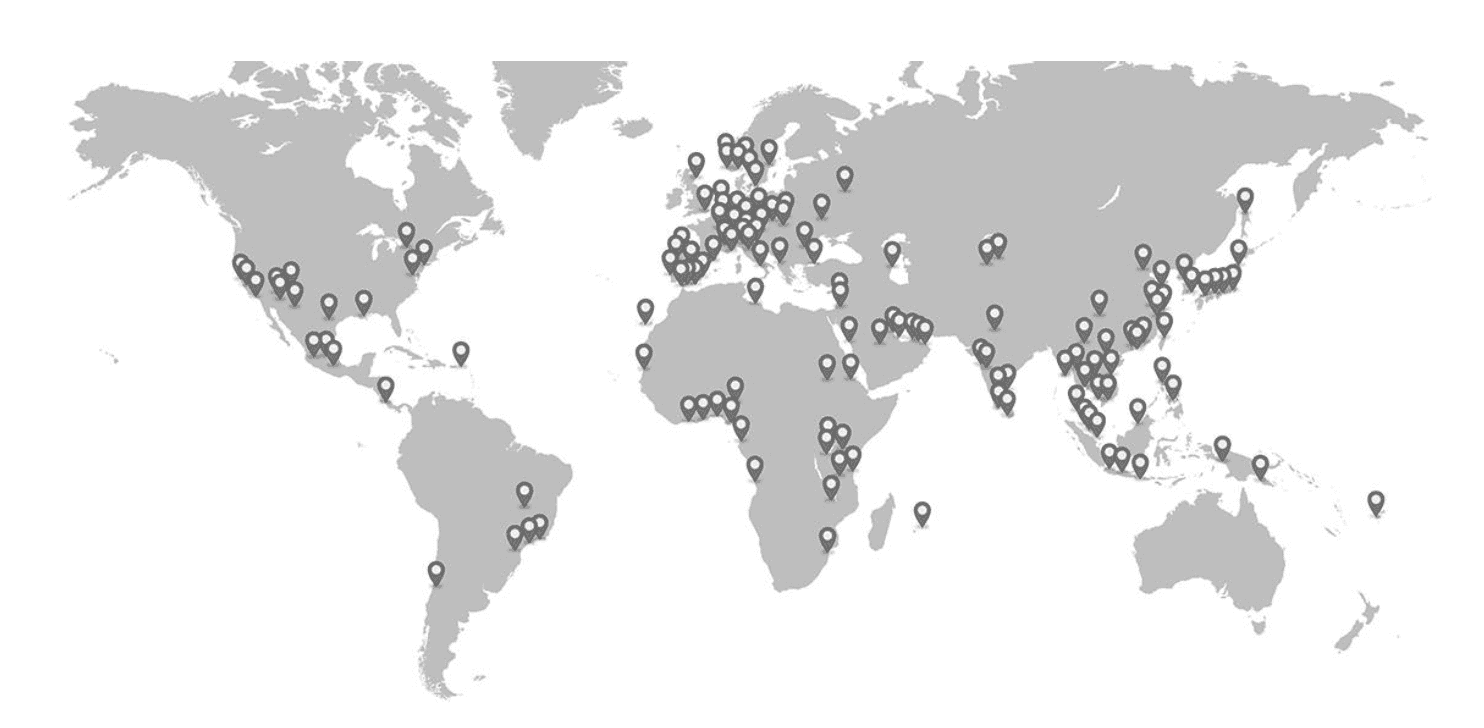
World map showing ISA participating schools across all continents
Each pin marks a city with one or more ISA-participating international schools -- the assessment now reaches roughly 60,000 students across more than 200 schools each year.

Who Takes the ISA in Singapore?

Several prominent Singapore international schools participate in the ISA. The following are confirmed participants based on published ACER data:

United World College of South East Asia—Dover (UWCSEA Dover Campus)

One of the most prestigious international schools in Asia, offering the IB curriculum.

United World College of South East Asia—East (UWCSEA East Campus)

UWCSEA’s second campus, also offering the IB curriculum.

Nexus International School Singapore

Known for its inclusive IB World School approach.

German European School Singapore

Offers both German and European curriculum tracks alongside IB.

Other participating Singapore schools:

GEMS World Academy, Hillside World Academy, Invictus International School, ISS International School, Middleton International School, NPS International School, One World International School, Dynamic World Montessori School, Sir Manasseh Meyer International School

School participation may vary by year. The list above is based on published ACER data from 2019–2023.

What Does the ISA Test?

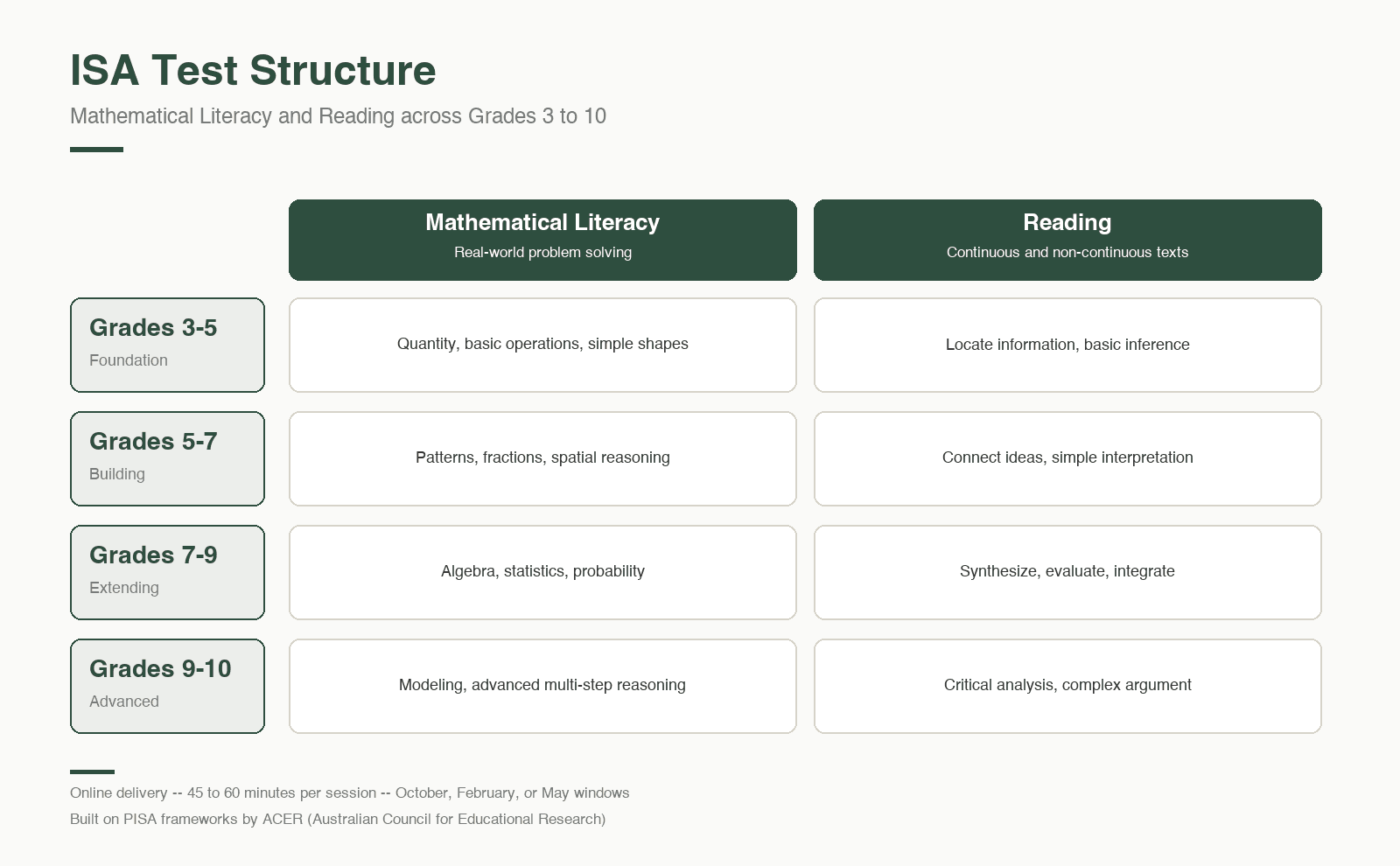
ISA test structure: Mathematical Literacy and Reading across Grades 3 to 10
ISA progressively raises difficulty by grade band. Cells summarise typical content -- the actual paper at each band uses age-appropriate stimuli.

Mathematical Literacy

Tests four content areas: Uncertainty & Data, Quantity, Space & Shape, and Change & Relationships. Three process skills: Formulating situations mathematically, Employing mathematical concepts, and Interpreting & evaluating results. The focus is on real-world problem solving, not just computation.
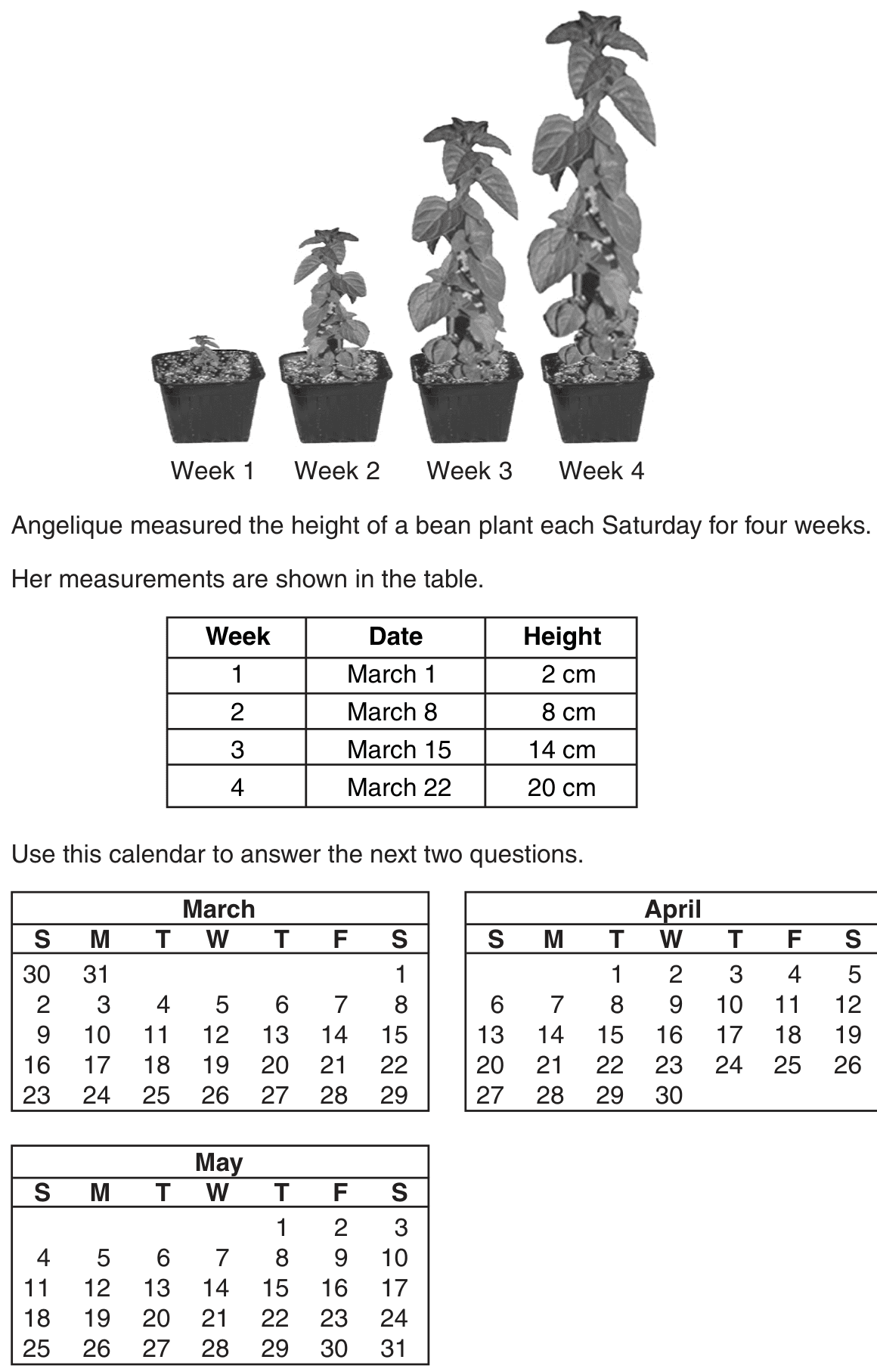
ACER ISA sample: bean plant growth measurement question with calendar
Sample math item from ACER: students reason about a bean plant's growth using measurement, tables, and calendar dates -- typical of how ISA blends literacy with computation.

Reading

Assesses three aspects: Access & Retrieve information, Integrate & Interpret meaning, and Reflect & Evaluate content and form. Uses both continuous texts (articles, essays) and non-continuous texts (graphs, maps, diagrams, tables).
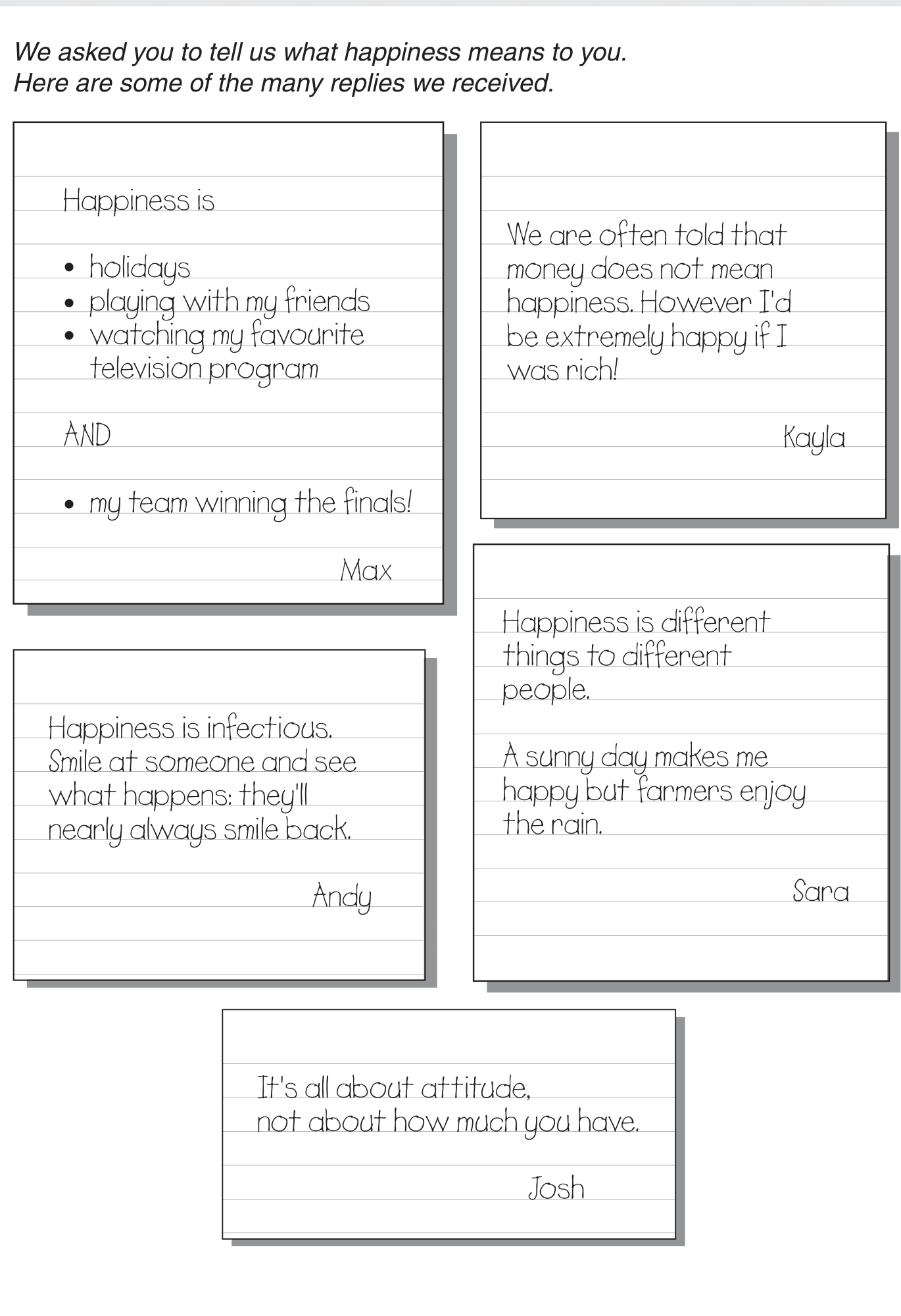
ACER ISA reading sample: handwritten responses to a question about happiness
Sample reading stimulus from ACER: students interpret authentic-looking handwritten notes -- a non-continuous text that mirrors how reading happens outside the classroom.

Writing

Two tasks: Narrative/Reflective Writing (scored on Content, Language, Spelling) and Exposition/Argument (scored on Content, Language/ESOL, Structure). Both tasks assess real communicative ability, not memorized formats.

Scientific Literacy

Three competencies: Evaluate & design scientific enquiry, Explain phenomena scientifically, and Interpret data & evidence scientifically. Three knowledge types: Content knowledge, Procedural knowledge, and Epistemic knowledge.

The ISA is not a curriculum-specific test. It assesses how well students can apply their knowledge to solve authentic, real-world problems—a philosophy shared with the PISA framework. This makes it equally relevant for IB, British, American, and other international curricula.

How is the ISA Delivered?

The ISA is an online assessment for all subjects across Grades 3–10. Schools choose from three administration windows: October, February, or May. Each testing session takes approximately 45 minutes to 1 hour.

Tests are administered by classroom teachers using detailed administration handbooks provided by ACER. The web-based platform works on Mac, PC, and iPad/tablet. Each student receives an individual login.

How is the ISA Marked?

Multiple-choice questions are auto-scored. Open-ended questions are hand-marked by trained marking staff with subject expertise, using detailed marking guides with criteria and sample responses. Markers are trained and monitored for consistency.

Scale scores are used instead of raw scores. The PISA scale sets the OECD average for 15-year-olds at 500 (standard deviation 100) from the year 2000 baseline. This means a Grade 3 student and a Grade 10 student are measured on the same scale within each domain, allowing direct comparison and tracking of growth over time.
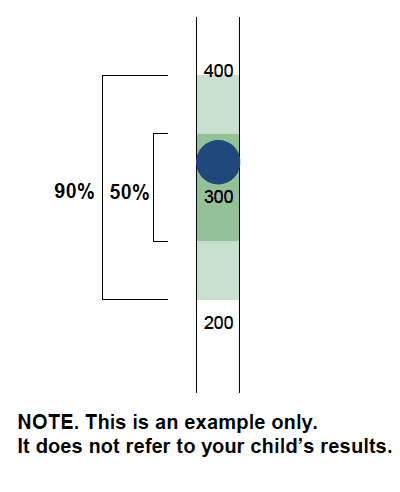
ACER ISA score scale example: vertical bar with 50% and 90% bands and a sample score dot
The official ACER scale: the dot marks a child's score, the inner band shows the middle 50% of same-grade students in the international cohort, and the outer band shows the middle 90%. A score above the inner band means the child is performing above the median for their grade.

Proficiency levels describe what students can do at each score range. Mathematical Literacy has 10 levels across 4 content scales. Reading has 10 levels across 3 aspects. Scientific Literacy has 9 levels across 3 competencies. Writing has 10 levels for Narrative and 9 for Exposition.

How to Read Your Child’s ISA Report

The individual student report is the most important document parents receive. Below are sample reports for Mathematical Literacy and Reading, using the same scale shown earlier in the Marking section.

ISA 2024 Mathematical LiteracySample Student | Grade 7

Students at this level typically:

Uncertainty & Data

1 Complete simple graphs from data
2 Sort and order data to create graphs
3 Locate info in simple graphs or tables
4 Solve problems using data in graphs
5 Locate statistical info in various forms
6 Interpret statistical info and link sources
7 Use basic statistical concepts to solve multi-step problems
8 Apply probability and statistics to analyse info
9 Use high-level reasoning in probability and statistics
200
300
400
500
600
700

Quantity

1 Count and compare numbers < 20
2 Solve simple problems with basic operations
3 Write, compare and order numbers
4 Solve problems with explicit info
5 Interpret simple tables and basic arithmetic
6 Use simple problem-solving strategies
7 Work with simple models of complex situations
8 Work effectively with models
9 Use advanced reasoning for multi-context problems
200
300
400
500
600
700

Space & Shape

1 Complete patterns of repeating shapes
2 Recognise and name 2-D shapes
3 Sort 2-D shapes by attributes
4 Recognise 2-D and 3-D connections
5 Solve simple spatial problems
6 Solve problems with single representation
7 Solve elementary visual/spatial reasoning
8 Solve problems in unfamiliar spatial contexts
9 Solve problems requiring assumptions and spatial reasoning
200
300
400
500
600
700

Change & Relationships

1 Identify simple counting patterns
2 Find and describe simple patterns
3 Perform simple calculations with patterns
4 Identify and analyse repetitive features
5 Read info from simple tables or graphs
6 Work with algorithms and link representations
7 Solve problems with multiple representations
8 Understand multiple representations of real situations
9 Use complex multi-step problem-solving
200
300
400
500
600
700
Middle 50%Middle 90%

Scroll horizontally to see all scales →

ISA 2024 ReadingSample Student | Grade 7

Students at this level typically:

Access & Retrieve

1 Find one piece of stated info in a short text
2 Work out info to be found in a short text
3 Put together simple clues in a short text
4 Find one or two pieces using low-level inference
5 Combine clues when some distracting info exists
6 Find info even with some distracting material
7 Work out what info is needed among distractions
8 Put together complex info from a challenging text
9 Put together complex info from confusing material
200
300
400
500
600
700

Integrate & Interpret

1 Work out important ideas in short text with pictures
2 Put main meanings together when clearly stated
3 Make meanings from a short text with clear ideas
4 Make broad meanings even when not obviously stated
5 Make some meanings even when not obviously stated
6 Show understanding of main ideas and relationships
7 Put together ideas in a text that presents challenge
8 Put together ideas when there is ambiguity
9 Show full understanding of complex text
200
300
400
500
600
700

Reflect & Evaluate

1 Give personal response to short simple text
2 Show beginning knowledge of text types
3 Show knowledge of text types; make personal response
4 Connect ideas in text and personal experience with reasoning
5 Connect ideas to personal experience, showing reasoning
6 Make comparisons with personal knowledge
7 Evaluate based on outside knowledge and experience
8 Critically evaluate based on external standards
9 Critically evaluate drawing on specialised knowledge
200
300
400
500
600
700

Scroll horizontally to see all scales →

Each scale lists nine proficiency levels along the vertical axis, from foundational skills at the bottom to advanced reasoning at the top. The numbers on the left (200, 300, 400, ...) are the same scale scores explained earlier in the Marking section.

The inner shaded band (middle 50%) shows where half of all Grade 7 students in the ISA Reference Norm sit. The outer band (middle 90%) shows where almost all Grade 7 students fall. A child whose score lands above the inner band is performing above the grade median; below it, there is room for growth.

Scoring methodology:

  • Scale scores (not raw scores) enable comparison across years and grade levels
  • Proficiency levels: Math has 10 levels across 4 content scales; Reading has 10 levels across 3 aspects
  • Internal consistency reliability: 0.78–0.88 across all domains
  • Calibration: Item Response Theory (IRT) places students on the scale
The ISA Reference Norm is based on over 50,000 students from more than 200 international schools worldwide. Your child’s results are compared against this diverse international cohort.

How Schools Use ISA Data

Schools receive multiple report types: Individual Student Reports, Class Reports, School Reports, National Comparison Reports, Interactive Diagnostic Reports, and Interactive Tracking Reports.

Schools use this data for benchmarking against the international norm, diagnostic analysis to identify areas of strength and weakness at class and school level, tracking progress over multiple years, and comparing with PISA country data for Grades 8–10 students.

Try Our Free ISA Sample Test

Help your child prepare by trying our free ISA sample questions. The tool includes official ACER sample materials for Mathematical Literacy and Reading, with instant feedback on multiple-choice questions and model answers for open-ended questions.
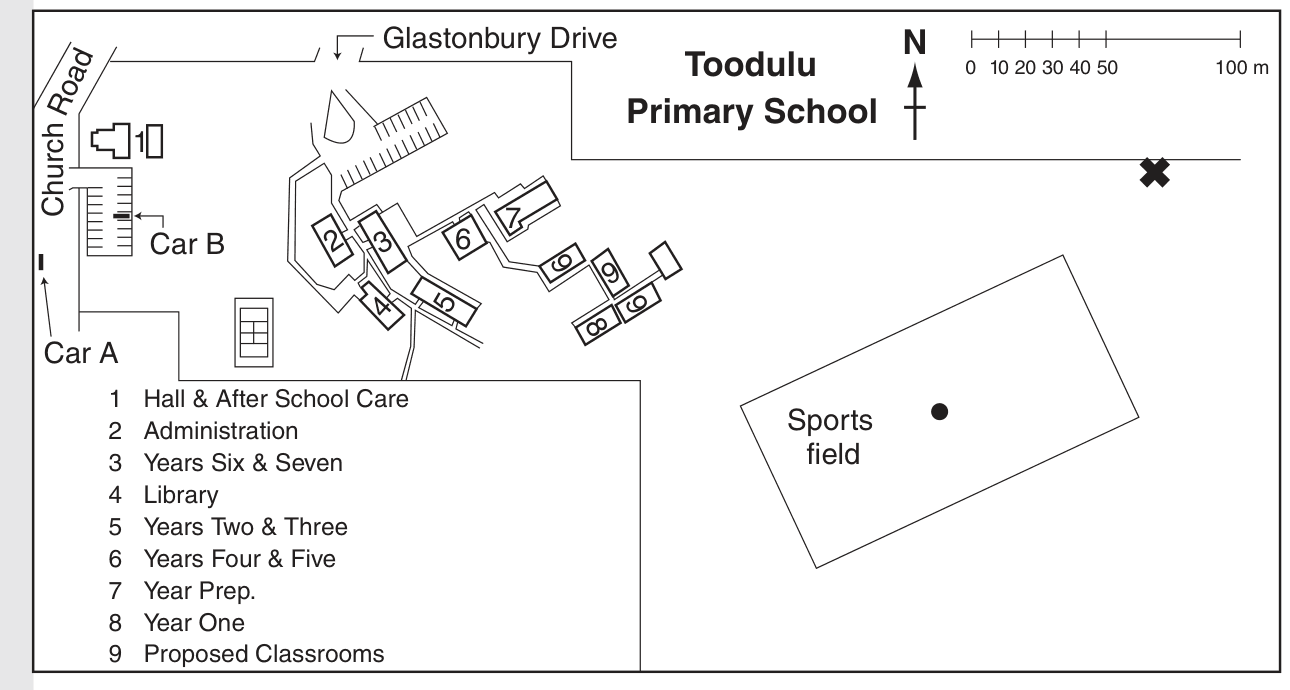
ACER ISA sample map question: Toodulu Primary School treasure hunt
Map-reading task from an ACER sample: students plan a route, calculate distances, and interpret a scale -- the kind of multi-step spatial problem the tool walks through with model answers.

Summary

The ISA provides Singapore international school families with a standardized, internationally benchmarked view of their child's academic capabilities. Unlike curriculum-specific tests, the ISA focuses on what matters most: whether students can apply their knowledge to real-world situations.

Understanding your child's ISA report helps you identify strengths, address weaknesses, and track meaningful progress over time. Combined with school-specific assessments, it gives a comprehensive picture of your child's academic development.

Frequently Asked Questions

What is the ISA test?
The ISA (International Schools' Assessment) is a suite of online tests developed by ACER (Australian Council for Educational Research) for international schools. It assesses Mathematical Literacy, Reading, Writing, and Scientific Literacy for students in Grades 3–10, based on the PISA frameworks.
Which Singapore schools participate in the ISA?
Key participants include UWCSEA (Dover and East campuses), Nexus International School, German European School Singapore, ISS International School, and others. School participation may vary by year.
What subjects does the ISA test?
The ISA tests four areas: Mathematical Literacy, Reading, Writing (Narrative and Expository), and Scientific Literacy. All are based on real-world application of knowledge, not curriculum-specific content.
How is the ISA different from PISA?
The ISA is based on PISA frameworks but is NOT part of PISA and NOT endorsed by the OECD. PISA tests 15-year-olds in national samples; the ISA tests Grades 3–10 in individual international schools. Both share the same assessment philosophy of real-world application.
What grades take the ISA?
The ISA is designed for students in Grades 3 through 10.
How long does the ISA take?
Each ISA session takes approximately 45 minutes to 1 hour. Schools administer the tests during scheduled windows in October, February, or May.
How are ISA results reported?
ISA results use scale scores based on PISA scales (OECD average for 15-year-olds set at 500). Scale scores allow comparing across grades and tracking growth over years. Individual reports show your child's score relative to the middle 50% and 90% of students at their grade level.
Can my child prepare for the ISA?
Since the ISA tests real-world application rather than memorized content, the best preparation is to familiarize your child with the question format. Our free ISA Sample Test tool includes official ACER sample materials with instant feedback.