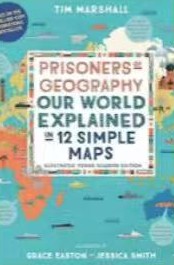
What This Book Is About
Why is North America so much more prosperous than South America? Why has Africa had such a troubled history? Can a single river change a nation's destiny? These are the kinds of questions that most adults struggle to answer clearly—but Tim Marshall does it brilliantly, using just 12 maps.
Twelve chapters, each on a different region: Russia, China, the USA, Western Europe, Africa, the Middle East, India and Pakistan, Korea and Japan, Latin America, the Arctic and others. Each one explains how mountains, rivers, deserts and coastlines set the limits on what that region's leaders can actually do. This illustrated young readers' edition, with maps by Grace Easton and Jessica Smith, makes complex geopolitical ideas feel intuitive and even exciting.
This is the children's edition of Marshall's adult bestseller of the same name, not the adult book itself: the argument is the same, the language and the presentation are pitched at readers aged 10 and up.
Available at Popular bookstores, Kinokuniya, and the Singapore National Library.
Why We Recommend This Book
For B1-level students at international schools, this book is an outstanding choice for three reasons.
First, it is non-fiction with heavy visual support. The maps and infographics mean that even when the vocabulary gets challenging, the visual context helps B1 readers keep up. This is exactly the kind of scaffolded non-fiction reading that builds confidence.
Second, it directly complements the social studies and humanities curricula at schools like UWCSEA, Tanglin, and Dulwich. The regions covered—Russia, China, the Middle East, Europe—are standard topics in IB MYP Individuals and Societies. Reading this book is genuine academic preparation disguised as fun.
Third, it teaches critical thinking about causation. Instead of memorizing facts, students learn to ask "why"—why do borders fall where they do, why do wars start in certain places, why do some countries develop faster than others. This analytical habit is exactly what international schools want to cultivate.
Reading Level Guide
May be challenging at A2. Build confidence with easier books first.
Perfect difficulty. Challenging enough to grow, accessible enough to enjoy.
A comfortable read at B2. Consider more challenging titles.
Other UWC Recommended Books for This Grade

Not sure if this book is right for your child? Take our free English assessment to find their CEFR level.