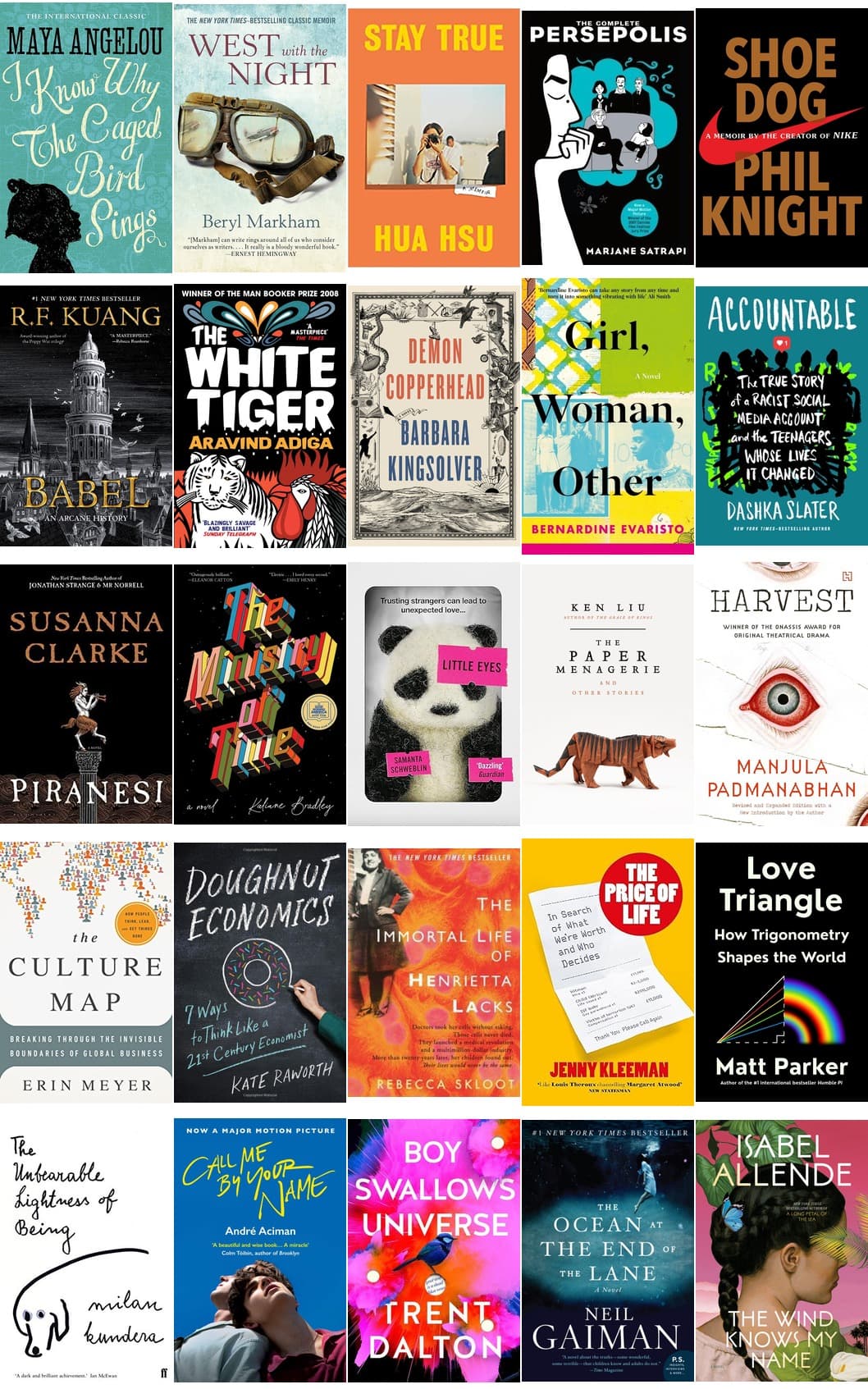
The jump from Grade 8 to High School isn't just about harder exams — it's about a fundamentally different relationship with knowledge. UWCSEA's IBDP recommended reading list reflects this shift. These aren't books chosen to fill a syllabus. They're books chosen to change how students think — about power, identity, economics, science, memory, and what it means to live in a world that doesn't come with easy answers.
The 25 books span five continents, eight languages of origin, and nearly every genre from graphic memoir to speculative fiction to behavioural economics. What connects them is ambition: each book asks its reader to hold complexity without flinching. For IB students who will write Extended Essays, defend TOK presentations, and navigate CAS reflections, these books are intellectual preparation disguised as pleasure reading.
The Weight of Memory
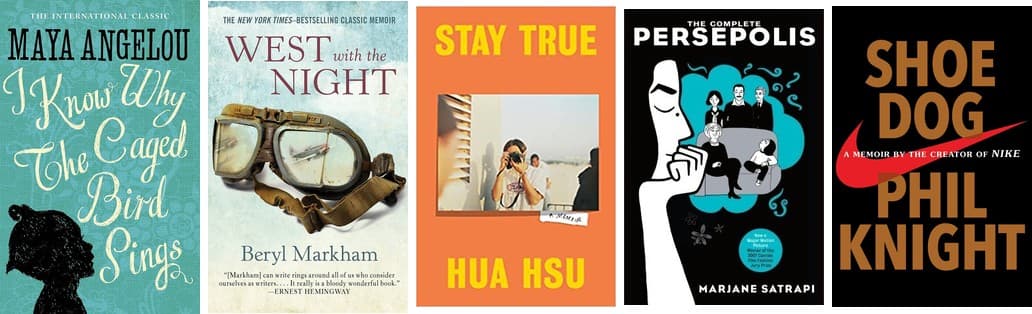
Memoir is the genre that asks: whose story gets told, and how does the telling change the teller? These five books span a childhood between Arkansas, St Louis and San Francisco, a racehorse trainer who became a bush pilot in Kenya, a Taiwanese-American student grieving his best friend in 1990s Berkeley, an Iranian girl who lives through the revolution and the war and then the years alone in Vienna, and a shoe importer who built Nike with his old track coach. What they share is the conviction that personal memory is never just personal: it is always political, cultural, and universal.
I Know Why the Caged Bird Sings
Maya AngelouAngelou's account of her childhood between Stamps, Arkansas, St Louis and San Francisco: racism, a childhood sexual assault, and the slow recovery of her own voice. It ends with the birth of her son when she is sixteen. The first of her seven autobiographies, and one of the most important memoirs in American literature.
West with the Night
Beryl MarkhamBeryl Markham grew up in Kenya, trained racehorses, and flew the bush. In September 1936 she became the first woman to fly the Atlantic solo east to west, running out of fuel and crash-landing in Nova Scotia short of her New York target. Her memoir reads like a novel: luminous prose about courage, solitude, and Africa.
Stay True
Hua HsuPulitzer PrizeA Pulitzer Prize-winning memoir about friendship, identity, and loss. Hua Hsu writes about his best friend Ken, murdered in a carjacking in 1998, and what it means to be young, Asian-American, and trying to figure out who you are.
The Complete Persepolis
Marjane Satrapi, translated by Mattias Ripa, Blake Ferris and Anjali SinghThe omnibus edition, collecting both parts of Satrapi's graphic memoir and told entirely in black-and-white panels. Part one is growing up in Iran through the revolution and the war. Part two follows her from fourteen, sent alone to school in Vienna, through drug dealing and use, a spell of homelessness, and the hard return to Tehran, a marriage at 21 and a divorce at 24. Funny, heartbreaking, and politically sharp, and a longer and more adult book than part one on its own.
Shoe Dog
Phil KnightKnight's memoir of the shoe-import business he started in 1964 on a $50 loan from his father and built with his old University of Oregon track coach, Bill Bowerman, into Nike: the near-bankruptcies, the fights with banks, the people around him. Part business memoir, part coming-of-age story, and surprisingly honest about failure, doubt, and obsession.
Power, Systems & Resistance
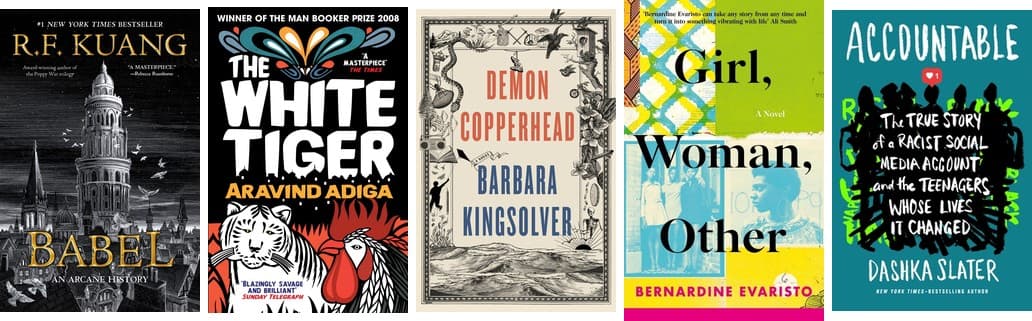
What happens when the system is designed to crush you, and you refuse to be crushed? These five books explore power from every angle: an Oxford student who discovers that translation is the engine of the British Empire's violence, an Indian driver who sees through the myth of democracy, an Appalachian boy trapped in America's opioid crisis, twelve characters, mostly Black British women, whose lives weave through a century of resistance, and the true story of a racist Instagram account at a California high school and what it did to everyone it touched. Together they form a masterclass in understanding that power is never neutral, and that resistance always has a price.
Babel
R.F. KuangRobin Swift is brought from Canton to Oxford to study translation — and discovers that the British Empire runs on the magic of silver bars powered by the gaps between languages. A fantasy novel that is also a devastating critique of colonialism, academic privilege, and the violence of translation.
The White Tiger
Aravind AdigaMan Booker PrizeBalram Halwai writes a letter to the Chinese Premier explaining how he murdered his employer and became an entrepreneur. Man Booker Prize winner — darkly comic, savage, and one of the sharpest novels about class and capitalism in modern India.
Demon Copperhead
Barbara KingsolverPulitzer PrizeA modern retelling of David Copperfield set in the opioid-ravaged mountains of Appalachia. Pulitzer Prize winner — funny, furious, and heartbreaking. Barbara Kingsolver's best novel, and one of the great American novels of this century.
Girl, Woman, Other
Bernardine EvaristoBooker PrizeTwelve characters — mostly Black British women — whose lives intersect across decades of British history. Joint Booker Prize winner with a form that breaks every rule: no full stops, fluid identities, stories that flow into each other like water. Challenging and exhilarating.
Accountable
Dashka SlaterThe true story of a private racist Instagram account run by one student at a California high school, followed by about a dozen classmates, and what happened afterwards to the student who ran it, the followers who said nothing, and the Black classmates it targeted. Slater follows all of them through the discovery, the expulsions, the lawsuits, the protests, and a restorative justice process that did not work. Essential reading on digital ethics and accountability.
Are these books the right level for your child?
Our free 30-minute assessment identifies their exact CEFR level (A1 to C1).
Imagining Other Worlds
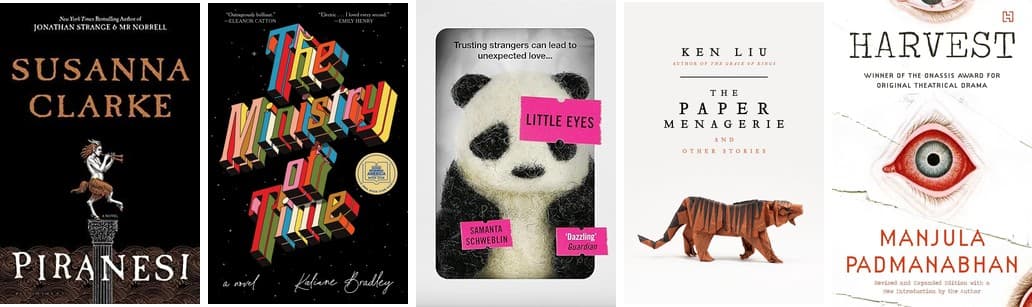
The best speculative fiction doesn't escape reality — it reveals it. These five books build impossible worlds to ask questions that realistic fiction can't: What if you lived in a house with infinite rooms and a sea that rises through the halls? What if your government sent agents back in time to steal people from history? What if strangers could watch your life through a networked toy animal? What if a mother's origami animals came alive? What if a future society made organ harvesting entertainment? They prove that genre fiction at its best is literature at its most ambitious.
Piranesi
Susanna ClarkePiranesi lives in a House with infinite halls, full of statues and tides. He knows every room, every bird, every skeleton. But he is starting to suspect that his world is not what it seems. A short, luminous, philosophical novel about knowledge, wonder, and the prisons we build without knowing.
The Ministry of Time
Kaliane BradleyThe British government develops time travel and brings historical figures to the present as an experiment. A civil servant is assigned to help a Victorian Arctic explorer adjust to modern life. What follows is a love story, a spy thriller, and a meditation on empire, displacement, and belonging.
Little Eyes
Samanta Schweblin, translated by Megan McDowellIn a near-future world, people buy networked toy animals called kentukis. You can either be a keeper or a dweller who sees through its camera from anywhere in the world. What starts as a cute premise becomes a deeply unsettling exploration of surveillance, intimacy, and control.
The Paper Menagerie and Other Stories
Ken LiuHugo + Nebula + World FantasyKen Liu's first collection gathers fifteen stories, published from 2002 onwards, across science fiction, fantasy and alternate history, often in the same story. The title story, about a Chinese mother who folds origami animals that come alive, won the Nebula Award for Best Short Story (2011), the Hugo Award for Best Short Story (2012) and the World Fantasy Award for Short Fiction (2012): three separate award cycles, and the first time any work of fiction had won all three. Stories about immigration, technology, mythology, and the weight of history.
Harvest
Manjula PadmanabhanIn a dystopian future, a family in a developing country sells the rights to their organs to a wealthy buyer in the West. A play about globalisation, bodily autonomy, and the economy of desperation — written in 1997 but more relevant every year.
Understanding How the World Works
IB students don't just study subjects — they study how subjects connect. These five nonfiction books model exactly that kind of thinking. One redraws economics as a doughnut instead of a growth curve. Another reveals how cultural differences make or break international teams. A third tells the story of a woman whose cells transformed medicine while her family got nothing. A fourth asks what a human life is worth, and who ends up putting the figure on it. And the fifth follows triangles through engineering, navigation, computing and design. Together, they're a crash course in seeing the systems behind the surface.
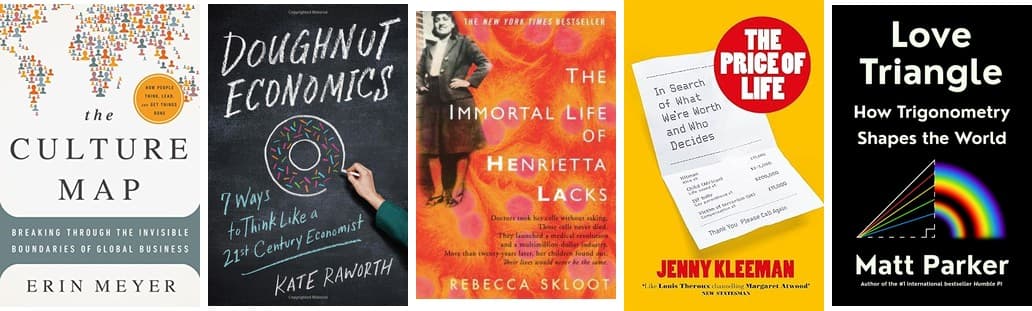
The Culture Map
Erin MeyerHow do you give negative feedback to a Dutch colleague versus a Japanese one? Why do Americans trust contracts while Chinese business culture relies on relationships? Erin Meyer maps cultural differences across eight dimensions. Essential for any student about to enter an international environment.
Doughnut Economics
Kate RaworthKate Raworth argues that 21st-century economics should aim not for endless GDP growth but for a sweet spot between human needs and planetary boundaries — shaped like a doughnut. A book that has influenced policymakers from Amsterdam to New Zealand.
The Immortal Life of Henrietta Lacks
Rebecca SklootHenrietta Lacks was a Black tobacco farmer whose cancer cells were taken without her knowledge in 1951. Those cells — called HeLa — became one of the most important tools in medicine. Her family didn't know for decades. A book about race, science, ethics, and who benefits from medical progress.
The Price of Life
Jenny KleemanWhat is a human life worth? Jenny Kleeman reports from the places where a cash figure actually gets put on one: the price of hiring a hitman, the cost of saving a child's life through aid work, the price of an IVF baby, and the compensation paid to UK terrorism victims. Provocative, unsettling, and exactly the kind of book that sparks TOK discussions.
Love Triangle
Matt ParkerMatt Parker's case that triangles and trigonometry run through everything, from engineering and navigation to computing and design. A joyful, funny book that proves mathematics is creative, beautiful, and far more interesting than your textbook suggests.
Love, Loss & Growing Up
The best novels about love are never really about love — they're about what love reveals. These five books use romance, family, and longing to crack open questions about time, memory, identity, and what we owe each other. A Czech novelist weighs lightness against weight through the Prague Spring and the invasion that ended it. An Italian summer becomes an awakening that will define a lifetime. An Australian boy growing up in a violent suburb discovers that the universe might be paying attention after all. A middle-aged man returns to his childhood neighbourhood and finds that the past is not as past as he thought. And a Viennese Jewish boy put on a Kindertransport in 1938 and a blind Salvadoran girl separated from her mother at the US border in 2019 turn out to be connected. Each of these novels demands that its reader feel, deeply, uncomfortably, beautifully.
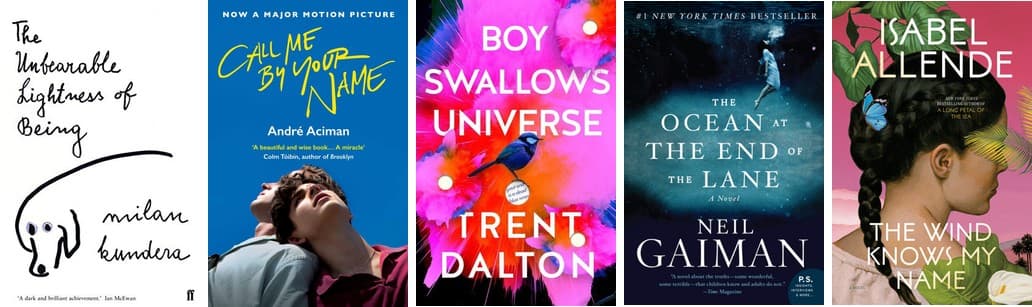
The Unbearable Lightness of Being
Milan Kundera, translated by Michael Henry HeimFour characters navigate love, politics, and philosophy in the shadow of the 1968 Soviet invasion of Czechoslovakia. Kundera asks whether our lives are defined by heaviness (commitment, meaning) or lightness (freedom, insignificance). One of the great European novels of the 20th century.
Call Me by Your Name
André AcimanNorthern Italy, summer 1983. Elio, seventeen, falls in love with Oliver, a twenty-four-year-old visiting scholar housed by Elio's father for six weeks. A novel about desire, identity, and the twenty years of memory that follow a single season. Luminous, sensual prose.
Boy Swallows Universe
Trent DaltonEli Bell grows up in 1980s Brisbane with a heroin-dealing stepfather, a mother in prison, and a mute brother who writes messages in the air. Based on the author's own childhood — violent, tender, magical, and one of the best Australian novels in decades.
The Ocean at the End of the Lane
Neil GaimanA middle-aged man returns to his childhood home and remembers the Hempstock family — three women who might be goddesses — and the terrifying events of his seventh year. A short, dark fairy tale about memory, childhood, and the things adults forget but children know.
The Wind Knows My Name
Isabel Allende, translated from the SpanishTwo stories of displacement connected across eighty years: Samuel Adler, a Viennese Jewish boy sent to England on a Kindertransport after Kristallnacht in 1938, and Anita Diaz, a blind Salvadoran girl separated from her mother at the US border in 2019. The two lines converge in present-day California. Isabel Allende weaves war, music, and migration into a story about the endurance of love across generations.
A Note for Parents
These books are selected for high school students preparing for the IB Diploma Programme. Many deal with mature themes — colonialism, political violence, sexual identity, economic inequality, and ethical dilemmas without easy resolutions. UWCSEA includes them precisely because IB students need practice engaging with complexity. If you're wondering whether your child is ready for these books, consider this: the IB itself requires students to analyse multiple perspectives, tolerate ambiguity, and form independent judgments. These books are training for exactly that.
Want to filter these books by level or genre?
Use our interactive book finder tool with cover images and CEFR filters.
Is your child ready for IB-level English?
Our free 30-minute assessment identifies their CEFR level (A1 to C1) and shows whether they're reading at the level these books demand.
Take the Free Assessment